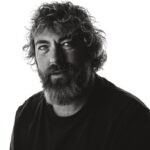
Put somebody against a plain background, and you can create a strong portrait.
You can study their expression, posture and the way the light falls across their face. There’s nowhere for them to hide and nothing else competing for attention.
I love that kind of portrait.
But sometimes a face alone isn’t the whole story.
Photograph a jewellery designer at the bench where they shape every piece. Put a filmmaker among the equipment they use to bring an idea to life. Photograph an artist in a studio marked by years of paint, experiments and unfinished work.
Now we’re learning something more.
The place isn’t simply sitting behind them. It’s helping us understand who they are.
That’s what an environmental portrait should do.
A location should earn its place
An environmental portrait is a photograph of somebody in a setting connected to their life, work or identity.
But including a location doesn’t automatically make the portrait meaningful.
You could photograph an accountant beside a laptop, a writer in front of some books or a business owner standing beneath their company sign. Those images provide context, but context alone isn’t always enough.
The setting should contribute something.
It might create atmosphere. It could reveal how somebody works, show what they value or introduce visual details that make the photograph more distinctive.
My test is simple.
If the person could be lifted from the photograph and placed somewhere else without changing its meaning, the location probably isn’t doing enough.
The best environmental portraits feel inseparable from their setting.
Familiar places change how people behave
Most people become more self-conscious when a camera points at them.
They suddenly wonder where to put their hands. Their shoulders tighten. They start trying to arrange their face into what they think a photographed face should look like.
A familiar place can help.
When somebody is photographed in their own studio, workshop or workspace, they have things around them that they understand. They can pick something up, move naturally through the room or show me how they do part of their work.
Instead of thinking only about the camera, they begin thinking about something they know.
That change matters.
Conversation flows more easily. Hands become occupied. Expressions become less guarded. The person starts behaving more like themselves.
I’ll still direct the portrait. I’ll choose the light, background and camera angle. I may move someone half a step or ask them to repeat a movement.
But their surroundings give us something real to work with.
For someone who feels nervous about being photographed, their own space can provide a kind of anchor.
Ordinary details can become visually interesting
People often apologise for their surroundings before I’ve taken the camera out of the bag.
They see a cluttered workbench, a crowded shelf or a small room they use every day.
I see layers, texture, colour and evidence of a life being lived.
A row of well-used tools can tell us more than a perfectly clean desk. Sketches pinned to a wall may reveal something about a creative process. Scratches, paint marks and unfinished work can add honesty to the photograph.
That doesn’t mean everything should remain exactly where it is.
Real places still need editing.
I might remove a distracting cable, shift a bright object or change my position so an untidy corner disappears. The aim isn’t to make the space look artificially perfect. It’s to decide which details help the story and which ones get in the way.
An environmental portrait doesn’t need to show the whole room.
Sometimes the most effective photograph uses only a narrow section of it.
A doorway.
A window.
A wall covered in ideas.
A pair of hands at work.
The camera can turn something very ordinary into something visually powerful, provided we know what deserves attention.
Meaning matters more than grandeur
A beautiful location can produce a beautiful photograph, but beauty isn’t the only goal.
The most meaningful setting may be quite modest.
It could be the spare room where a business began. The workshop somebody built themselves. The corner of a kitchen table where a first product was designed. The piece of landscape somebody walks through whenever they need to think.
Those places carry personal history.
That history won’t always be obvious to the viewer, but it often changes the way the subject occupies the space. They stand differently. They engage with their surroundings naturally. They have stories to tell while we work.
That emotional connection can give the portrait something a more impressive but unrelated location can’t.
When choosing a setting, don’t ask only, “Where will look good?”
Ask, “Where makes sense for this person?”
Ideally, we find somewhere that does both.
Place can add several layers to one portrait
A strong environmental portrait works at different distances.
From across the room, it might show a person surrounded by their work.
Move closer, and the emphasis shifts towards their expression.
Closer again, and a detail photograph might show their hands, materials or tools.
Together, those images build a richer picture of the person.
This is especially useful for creatives, makers and independent businesses. One session can produce a hero image for the website, portraits for social media and smaller details that help tell the story over time.
The variety comes from exploring the place rather than repeatedly moving the person in front of different backgrounds.
Before the shoot, think about the parts of your environment that matter most.
Where does the real work happen?
Which objects do you use every day?
Is there a place where you naturally pause, think or talk to clients?
What would somebody need to see to understand your world a little better?
Those answers help turn a location into a story.
The place shouldn’t overwhelm the person
There’s a balance to find.
If the setting becomes too busy, the person can disappear inside it. If everything is too neat and controlled, the portrait can lose the character that made the location useful.
My job is to decide what leads the eye.
Lighting can separate the person from the background. Composition can remove distractions. Depth of field can keep enough context visible without making every object equally important.
The person must remain the subject.
The location is there to support them, not compete with them.
Sometimes we need to look beyond the obvious place
The most literal location isn’t always the most effective.
A writer doesn’t have to be photographed staring at a laptop. A musician doesn’t need to hold an instrument in every frame. A designer’s portrait doesn’t have to show every product they’ve ever made.
Sometimes a nearby corridor has better light. A doorway creates a stronger composition. The outside of the building says more about the business than the room inside it.
We can also combine the obvious photographs with less expected ones.
First, we establish the context.
Then we look for atmosphere, expression and moments that feel more personal.
That’s where an environmental portrait becomes more than an illustrated job description.
A portrait of a person and their world
I’m interested in people, but I’m also interested in the spaces they create around themselves.
The tools they keep close.
The objects they choose to display.
The places where they feel comfortable.
All of those things offer clues.
A good environmental portrait brings those clues together without needing to explain everything. It gives the viewer enough information to become curious about the person in the frame.
And, just as importantly, it gives that person a setting in which they can relax and show more of themselves.
If you’re a creative, maker or business owner in Cranleigh, the Surrey Hills or nearby, I’d love to photograph you in a place that matters to you.
Show me where your work happens, tell me what makes it meaningful, and we’ll create portraits that carry some of that story with them.