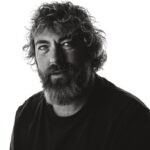
The Surrey Hills are photographed constantly.
Rolling countryside. Misty mornings. Woodland. Vineyards. Beautiful villages. Views from the top of Box Hill.
All lovely.
But, for me, the most interesting thing about this place is the people.
That’s really where The Surrey Hills Portrait came from.
I wanted to create something that went beyond photographing the landscape and started documenting the people who live, work and create here.
Not just the obvious names either.
I’m interested in the business owners, makers, performers, filmmakers, publicans, charity leaders, artists and people quietly building interesting things.
The people behind the place.
One person. One conversation. One portrait.
The format is deliberately simple.
I sit down with someone for a proper conversation, usually for around half an hour, and then I make their portrait.
No complicated production. No panel discussions. No attempt to turn it into a glossy business podcast where everyone pretends they had a perfectly planned journey from A to B.
I want to know how people actually got here.
What they care about.
What went wrong along the way.
Why they’ve chosen to do what they do.
And what their connection is to this part of Surrey.
The first five recordings have already taken me in completely different directions.
I’ve spoken to filmmaker Ben Seale, whose journey took him from the Swiss Air Force into British television and eventually into running his own production company.
I’ve heard Mandira Sarkar describe a childhood growing up among the tea gardens of Assam before building a very different life here in Surrey.
I’ve talked to Lisa Duncan about forest bathing, nature and the strange routes our lives sometimes take before we find the thing we’re meant to be doing.
I’ve sat down with Will Hammond from Cherry Trees to talk about community, families and the enormous difference a relatively small charity can make.
And I’ve recorded a conversation with Jo and James Dearsley, who’ve taken on The Six Bells in Newdigate and are throwing themselves into the slightly mad challenge of running a village pub.
Some of those episodes won’t have been published by the time you read this.
But recording them has already confirmed something I suspected.
Interesting people are everywhere around here.
You just have to give them enough time to tell their story.
Why now?
I’ve been connected with the Surrey Hills professionally and personally for years.
I’m a member of Surrey Hills Enterprises, I hold the Trade Mark Surrey Hills, and in 2022 I was incredibly proud to become the first individual to receive the Gold Trade Mark Surrey Hills Award.
That recognised my commitment to the Surrey Hills, the Cranleigh community and encouraging other people to get involved.
At the time, photography wasn’t as central to my working life as it is today.
Now it is.
And that makes this feel like the right moment to bring several strands of my life together.
I’ve spent years interviewing people.
Before returning to photography full-time, I hosted and produced close to 1,000 podcast episodes. I’ve interviewed authors, business owners, journalists, academics, economists and plenty of people who were far more interesting than their job titles suggested.
I’d missed that.
The conversation.
The moment when somebody stops giving the answer they think they’re supposed to give and starts telling you what they actually think.
Photography has something similar.
A portrait session often starts with somebody being very aware of the camera. Then, somewhere along the way, they relax. The performance disappears slightly.
That’s usually when the best photograph happens.
Putting those two things together feels very natural.
It’s also an excuse to be curious
There’s a practical lesson here for anyone trying to build a creative business.
You don’t always need another marketing campaign.
Sometimes you need a project that gives you permission to meet interesting people.
That’s partly what this podcast does for me.
It creates a reason to knock on someone’s door and say, “You seem interesting. Can I come and talk to you?”
That conversation might introduce me to a business I didn’t know existed, a different part of the Surrey Hills, an idea I hadn’t considered or a person doing something completely outside my usual world.
Some of those people may eventually become clients. Some will become friends or collaborators. Most probably won’t become either.
That’s fine.
The project still has value.
I think creative work gets more interesting when not everything has to produce an immediate financial return.
The portrait matters just as much as the podcast
This isn’t a podcast with a photograph attached as an afterthought.
The portrait is part of the point.
I want to gradually build a visual record of the people shaping this area.
Not necessarily the most famous people.
Not even necessarily the most successful.
Just people with something worth saying and a story worth recording.
Over time, I’d love that collection to become something much bigger.
A genuine portrait of the Surrey Hills, told through faces rather than scenery.
Because places aren’t really defined by boundaries on a map.
They’re defined by people.
The person opening the village pub at ridiculous o’clock in the morning.
The filmmaker trying to build a different kind of production company.
The person running a charity most of us will hopefully never need.
The maker working alone in a workshop.
The artist, grower, performer, volunteer or small business owner creating something useful.
Those are the stories I want to find.
Who should I photograph next?
The Surrey Hills Portrait is published weekly, with a new conversation and portrait each episode.
If you live, work or create in the Surrey Hills, or you know somebody with a brilliant story that deserves a wider audience, I’d love to hear about them.
They don’t need a huge following.
They don’t need an impressive job title.
They just need an interesting story.
Listen to The Surrey Hills Portrait, share an episode with someone who’ll enjoy it, and if there’s somebody you think I should sit down with next, send me their name.
There are a lot more portraits still to make.